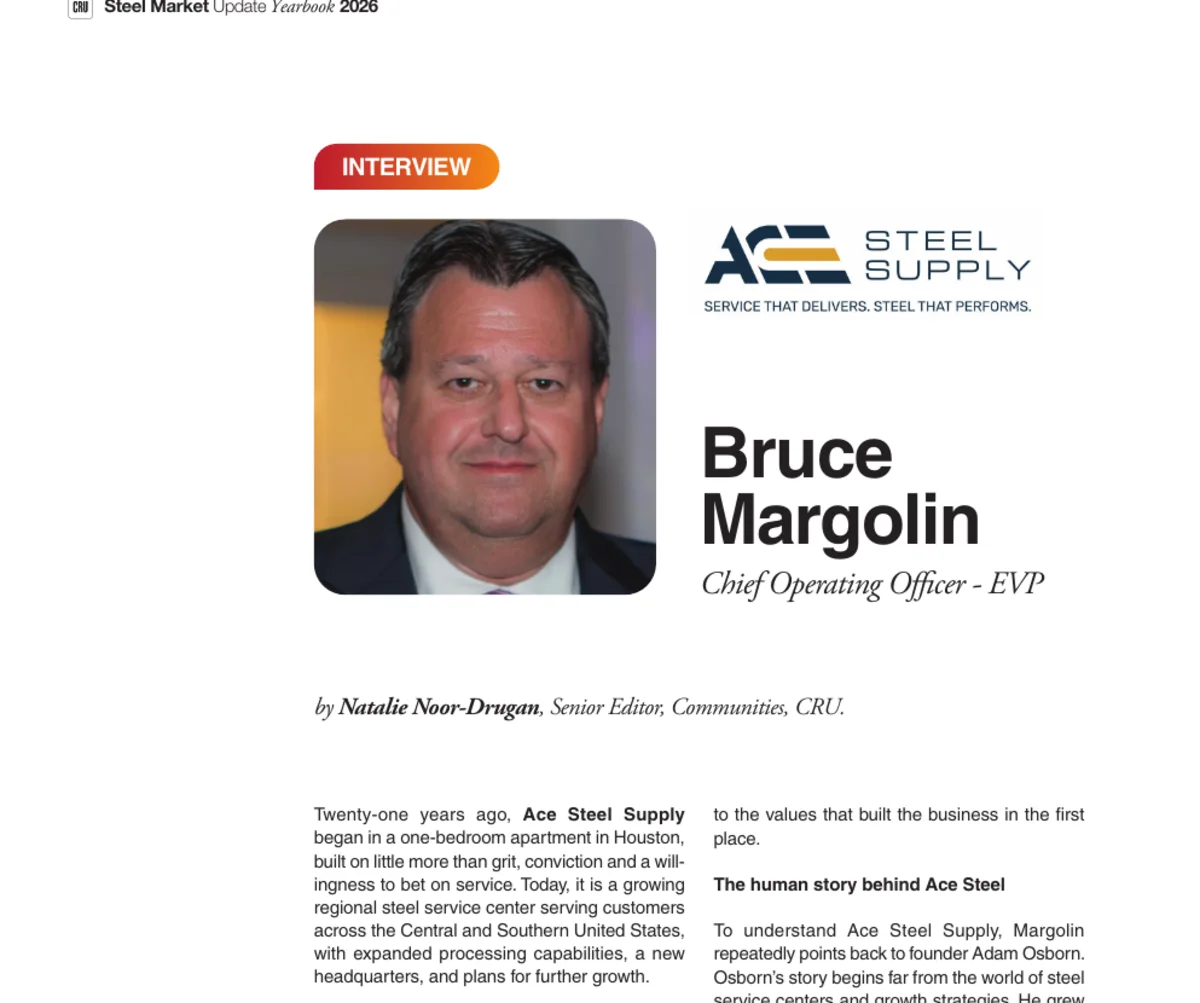
In this six-page interview, Bruce Margolin explains how Ace Steel Supply has grown from a one-bedroom Houston startup into a regional steel service center while staying focused on personal service, accountability, and trust.
Written by Natalie Noor-Drugan, Senior Editor, Communities, CRU, for the Steel Market Update Yearbook 2026.
Growth built on service, people, and disciplined execution
Margolin traces Ace Steel Supply’s identity to founder Adam Osborn, whose work ethic, willingness to take calculated risks, and belief that relationships matter more than transactions shaped the company from its beginning in 2005. He also recognizes Barbara Pennington’s lasting influence on Ace’s culture of genuinely caring for customers.
Since joining Ace in 2019, Margolin has helped strengthen the systems needed to support growth without losing that entrepreneurial character. The interview describes a company guided by its 1ST CREDO, weekly EOS leadership practices, ISO 9001:2015 discipline, and a commitment to developing people who solve problems and take ownership.
The article also explains what Ace means by offering “boutique service in a commodity industry”: customers reach knowledgeable people, receive responsive and personalized support, and can rely on commitments such as the two-hour will-call protocol. Margolin summarizes the goal as becoming the company customers trust most, not simply the biggest.
Looking ahead, Ace is investing in expanded facilities, INVEX, and AI-supported tools. The purpose, Margolin says, is not to replace people, but to give talented professionals better information and insights so they can serve customers more effectively.
“We don’t want to be the biggest. We want to be the company customers trust the most.”
Key themes from the interview
Preserving founder Adam Osborn’s emphasis on relationships, resilience, training, and attention to detail.
Building a customer-first culture around communication, ownership, responsiveness, and trust.
Pairing entrepreneurial energy with stronger systems, ISO 9001:2015 discipline, and continuous improvement.
Investing ahead of growth through a new headquarters, INVEX, and practical uses of AI.
Read the complete interview
Read the full interview below, or download the original Steel Market Update Yearbook article.
By Natalie Noor-Drugan, Senior Editor, Communities, CRU.
Image: ACE Steel Supply.
Twenty-one years ago, Ace Steel Supply began in a one-bedroom apartment in Houston, built on little more than grit, conviction and a willingness to bet on service. Today, it is a growing regional steel service center serving customers across the Central and Southern United States, with expanded processing capabilities, a new headquarters, and plans for further growth.
The story, as Bruce Margolin, Chief Operating Officer of Ace Steel Supply, tells it, is not simply that the company has grown. It is how it has grown. “We started with an entrepreneurial spirit, a willingness to take calculated risks, and an unwavering commitment to servicing customers better than anyone else,” Margolin says. “Today, we’re operating from one of Houston’s premier steel service centers, but we’ve never lost that entrepreneurial mindset. We continue to invest ahead of our growth, improve our systems, hire exceptional people, and constantly challenge ourselves to become better, not just bigger.”
That phrase—“better, not just bigger”—sits at the heart of the Ace story. It captures the company’s journey from a founder-led start-up to a more sophisticated service center with deeper operational discipline, but it also points to something more personal: a determination to hold on to the values that built the business in the first place.
The human story behind Ace Steel
To understand Ace Steel Supply, Margolin repeatedly points back to founder Adam Osborn. Osborn’s story begins far from the world of steel service centers and growth strategies. He grew up on a farm in Missouri, in difficult circumstances, before serving four years in the US Navy and then heading to Houston in search of opportunity. After returning to civilian life, he worked relentlessly—at one point juggling three jobs—and then began learning the steel business from the ground up, first in warehousing and then in sales.
Ace Steel Supply founder, Adam Osborn, serving in the US Navy. Image: ACE Steel Supply.
By the time he launched Ace in June 2005, Osborn had already built a reputation for work ethic and commercial instinct. To get the company off the ground, he emptied his retirement accounts and borrowed 450,000 dollars from his grandmother. Six months later, the business had generated around 1.8 million dollars in sales.
For Margolin, however, the most important part of Osborn’s legacy is not the risk he took, but the philosophy behind it. “Adam believed in training people and attention to detail,” he says. “And he believed relationships were more valuable than transactions themselves. He believed in a consultative sales approach and wasn’t afraid to have difficult discussions, make difficult decisions, or invest where others wouldn’t if it meant better service for customers.” Those beliefs, Margolin says, still shape Ace today.
The same is true of the influence of Barbara Pennington, Osborn’s mother, who joined the business in its earliest days after a career in industrial distribution, including stainless steel. Margolin speaks about her with genuine warmth. “Barbara helped establish a culture of genuinely caring about customers,” he says. “Day in and day out, she went out of her way to help her customers. Today, we measure customer service through responsiveness, communication, ownership, and trust. Anyone can process an order. We want customers leaving every interaction believing that Ace truly cared about helping them succeed.”
That emphasis on care is not accidental or ornamental. It is part of Ace’s inheritance. Pennington’s contribution is now recognized through the annual Barbara Pennington Customer Service Award, created to honor an employee who demonstrates exceptional service to internal and external customers alike. The award reflects a larger belief at Ace: customer service is not a department, but a responsibility shared across the company.
Adam and Kara Osborn with his mother, Barbara Pennington, celebrating a milestone at Ace Steel Supply. Image: ACE Steel Supply.
There is also a more difficult chapter in Osborn’s story that still echoes through the business. He spent eight years battling cancer while continuing to lead and invest in the company’s future. Margolin does not speak about that lightly. “Adam demonstrated extraordinary resilience,” he says. “He showed everyone that adversity doesn’t define you, but more your response does. That experience helped build a culture where we don’t make excuses. We’re fighters. We solve problems. It also reinforced the importance of building something larger than ourselves, a company that continues to grow and serve customers long into the future.”
Preserving the vision
When Margolin joined Ace as Chief Operating Officer in January 2019, he arrived at a pivotal moment. The company was growing, but Osborn also knew it needed stronger systems, more structure and a more scalable operating model if it was going to endure. As his health worsened, that urgency only intensified.
Margolin was brought in to help lead that transition, but what comes through strongly in his account is that he does not present himself as the architect of Ace’s identity. His role, as he frames it, has been to help preserve and strengthen something that was already there.
That mindset can be seen in the company’s language about itself: built on vision, driven by people, defined by continuous improvement. For Margolin, those are not abstract words. “Vision gives us direction. People make everything happen. Continuous improvement means we are never satisfied with yesterday’s success,” he says. “Every department continually asks the question: how can we do this better tomorrow and in the future? That’s become part of our daily culture here.”
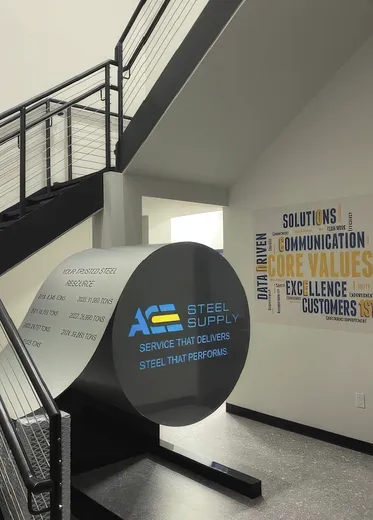
The same conviction comes through when he talks about Ace’s 1ST CREDO: Customer First, Communication, Results, Excellence, Data-Driven, Solutions. He is clearly enthusiastic about it, but not in a rehearsed or corporate way. He speaks like someone who has spent years watching whether values actually survive contact with reality. “This first credo, it’s not something that’s just hanging on a wall,” he says. “It’s really how we make decisions. It’s a culture that we need everyone that is within our walls to believe in and to practice. It’s not just window dressing.”
He then unpacks each element with unmistakable belief. “Customer First reminds us of who we serve. Communication keeps problems from becoming crises. Results emphasize execution, because talk is cheap. It’s the results that matter. Excellence means details matter. Data-driven means facts outweigh opinions. And Solutions reminds us that we don’t simply identify problems, but more, we solve them.”
That focus on execution is reinforced by the systems Ace has adopted. The company operates under the Entrepreneurial Operating System, or EOS, which provides the structure for weekly leadership meetings, clearer priorities, accountability and problem-solving. “The EOS L10 meetings take place in “The Forge”, where the Leadership Team comes together for ninety minutes every week to work on the business, not just in it”, explains Margolin.
Ace also achieved ISO 9001:2015 certification on Feb. 1, 2024, which it sees less as a badge than as an operating discipline around process control, accountability, risk management and continuous improvement. For Margolin, these systems matter because they help turn intention into habit. They give the company a way to preserve entrepreneurial energy without allowing it to drift into inconsistency.
That commitment to people is reflected in the caliber of Ace’s team. Ace has had two SMU NexGen Leadership Award recipients: Austin Reynolds in 2022 and Kimberlie Henry in 2025. These awards, along with Great Place to Work certification, reinforce Margolin’s view that the company is “building leaders and building people, and providing opportunities—not simply managing employees.”
He believes investing in people ultimately creates better service, better innovation and a stronger company.
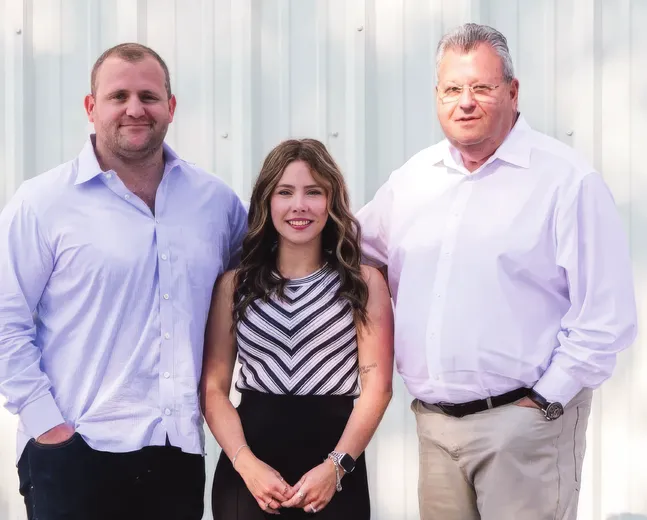
Bruce Margolin with the 2022 and 2025 SMU NexGen Leadership Award recipients: Austin Reynolds and Kimberlie Henry. Image: ACE Steel Supply.
The Melting Pot
That philosophy is captured in one of Ace’s most distinctive internal symbols: its all‑purpose meeting room, known—quite fittingly for a steel business—as the Melting Pot. The name is partly tongue‑in‑cheek, but the expectations inside are not. On the wall, a bold statement sets the tone: “Excellence isn’t just a skill, it is an attitude. Urgency isn’t optional, it’s essential. The art of execution is our signature. It’s what defines Team ACE.”
All of Ace’s public areas and rooms have names tied to the steel industry, and the Melting Pot is the one that brings everyone together. As Margolin explains, “We chose to name our all‑purpose room the Melting Pot because that’s exactly what happens there. Different ideas, different departments, different perspectives come together to assure we’re aligned as a company.” The space doubles as a lunchroom, training venue and the setting for quarterly all‑company meetings and holiday celebrations. “In the end, meetings should create clarity, alignment and action, not just simply fill the calendar,” he says.
Boutique service in a commodity industry
Ace describes itself as a boutique service center in a commodity industry, and Margolin is quick to explain what that means. “Steel may be a commodity, but our service is not,” he says. “Boutique means personalized attention, responsiveness, flexibility, and genuine relationships. Customers know they’ll reach people here who understand their business and take ownership of solving problems.
That is not just a slogan. It is central to how Ace wants to be experienced. In a market where more companies rely on automated systems, outsourced answering services and increasingly impersonal customer interfaces, Margolin’s view is firm: “People do business with people. And people really do business with people they like.”
He becomes particularly animated when describing the frustration customers feel when they cannot get a real person on the line. “Nothing bothers me more than these voice mail or automated attendant mazes. You call a company, press one, press three… and after you go through a maze, eventually it’s like no one even answers the phone,” he says. “If we’re really going to be service focused, we have to be personalized. We’ve built our business here from top to bottom as a company of people and a people business.”
That belief is reflected in specific service commitments. One example is Ace’s two-hour will-call protocol, designed for jobbers and other customers who need material quickly and do not want to wait. “If someone calls in an order, if they give us two hours and they show up here after that two-hour period, we will have the order ready for them,” Margolin says. “We have been religious about this, and it’s helped us develop a certain segment of business.”
Customers also benefit from the breadth of Ace’s offering. Its product mix includes hot rolled, pickled and oiled, cold rolled, galvanized, galvannealed, Galvalume, painted material, Bonderized, Corten, stainless steel, aluminum, prime, excess prime, secondary material, slit coil, sheet, plate, blanks and specialty products. Over time, the business has added its own processing capabilities, transforming itself from a traditional distributor into a full‑service steel service center with greater flexibility, quality control and responsiveness.
Margolin sums up the customer proposition simply: “One supplier, one relationship, one solution.” He adds that Ace brings consultation, inventory, supply programs, processing and market perspective to that relationship. The objective, in his telling, is not simply to sell steel, but to become a trusted supply chain partner. “We don’t want to be the biggest,” he adds. “We want to be the company customers trust the most.”
Image: ACE Steel Supply.
Investing ahead of growth
Ace’s physical growth over recent years has been substantial. Since 2019, revenue has grown significantly. Yet the more revealing story is how deliberately the company has invested ahead of that growth.
In September 2025, Ace relocated into its new Kenswick headquarters and distribution facility, creating the infrastructure needed for further expansion. Its primary slit line became operational in October 2025, and leadership soon committed to a further 30,000‑square‑foot expansion project, scheduled to begin construction in September 2026. The project is intended to increase coil storage capacity, improve workflow, create efficiencies and leave room for future processing capabilities.
Image: ACE Steel Supply.
At the same time, the company is preparing to implement INVEX, a next-generation ERP platform, in August 2026. It is also exploring artificial intelligence initiatives designed to improve visibility, decision-making, efficiency and customer responsiveness. Here again, Margolin’s thinking is balanced rather than breathless. He is clearly excited by technology, but equally clear about its purpose. “The objective is not to replace people,” he says. “The objective is to empower talented professionals with better information, better tools, and better insights.”
Technology and systems are only part of how Ace is preparing for what comes next. Ace tracks tariffs, trade laws, supply chain shifts, interest rates, inflation, manufacturing trends and wider economic developments, not just to stay informed but to give customers a clearer view of what may be coming. “Our responsibility extends beyond supplying steel,” Margolin says. “We strive to be a trusted business partner capable of providing perspective, market intelligence and practical guidance that helps customers become more successful.”
The soul of the business
In May 2022, Ace entered a new chapter when it was acquired by Commercial Steel Products, a subsidiary of Dallas-based family office Gupta Capital. That move brought new resources and strategic support, but the emotional center of the story remains elsewhere. It remains with the founder who took a risk in 2005, the mother who embedded the discipline of customer care, and the team that now sees itself as responsible for carrying that legacy forward.
That is what gives the company’s story its warmth. Ace is not simply presenting itself as a well-run steel business, though it clearly wants to be seen as that. It is also presenting itself as a company shaped by hardship, loyalty, work ethic and the belief that growth only matters if it deepens service rather than dilutes it.
Margolin’s enthusiasm makes that message persuasive. He speaks with conviction about systems, service, data, people and performance, while keeping the spotlight firmly on Ace and its team. Again and again, he returns to the team, to the customer, and to the values established before he arrived. That combination of belief and humility may be one reason the story resonates.
In today’s US steel market, Ace Steel Supply offers a familiar but increasingly difficult proposition: that in a commodity business, what still matters most is not only scale, product range or technology, but trust. And trust, as Margolin sees it, is built in the details—through responsiveness, discipline, communication, ownership, and the willingness to keep getting better.
“We’re proud of what has been accomplished,” he says. “But make no mistake. The best is yet to come.”